Generative AI is rapidly reshaping customer service, turning support teams from reactive problem solvers into proactive, experience-driven partners for the business. Instead of static FAQs and rigid chatbots, organizations can now offer dynamic conversations, instant answers, and deeply personalized support at scale through generative AI for customer service.
Whether you lead a support team, manage a contact center, or own a growing business, embracing AI adoption in business call centers and leveraging AI Call Center Solutions to Improve Agent Productivity can help you handle more inquiries, resolve issues faster, and deliver the kind of experiences that keep customers coming back.
Today ,businesses need more than just standard support tools to remain competitive. Companies exploring cutting-edge cloud computing platforms are discovering new ways to scale their AI-driven customer interactions while keeping operational costs manageable. By integrating advanced systems, teams can respond to customer needs instantly, reducing wait times and boosting satisfaction.
Meanwhile, organizations looking to leverage high-performance computing are increasingly turning to supercomputer solutions for analytics and AI. These platforms enable predictive insights, better handling of complex queries, and smoother customer journeys, making the support experience feel more intuitive and human.
Marketing teams also benefit when AI is applied to customer-facing operations. With strategies guided by innovative marketing tactics for customer engagement, businesses can ensure that automated interactions feel personal, relevant, and timely. Incorporating AI tools helps brands maintain consistent communication while freeing agents to focus on higher-value interactions.
For companies aiming to optimize campaigns and enhance customer retention, advanced AI-assisted marketing for customer satisfaction provides actionable insights. These tools analyze customer behavior, track engagement trends, and recommend personalized solutions that drive loyalty and repeat business.
Finally, finance and operations teams can also reap benefits from generative AI. Leveraging top financial resources for AI-driven business decisions ensures that companies make smarter investments in technology while improving ROI on customer service initiatives. This holistic approach helps businesses combine operational efficiency with an exceptional service experience.
Top 10 Contact Center Solutions for Generative AI in Customer Service
Generative AI is transforming how businesses manage customer interactions, allowing support teams to provide faster, smarter, and more personalized service. Choosing the right contact center solution can make a huge difference in customer satisfaction and agent efficiency. Here are the top 10 solutions in the market today.
1. Bright Pattern: Leading AI Contact Center Platform
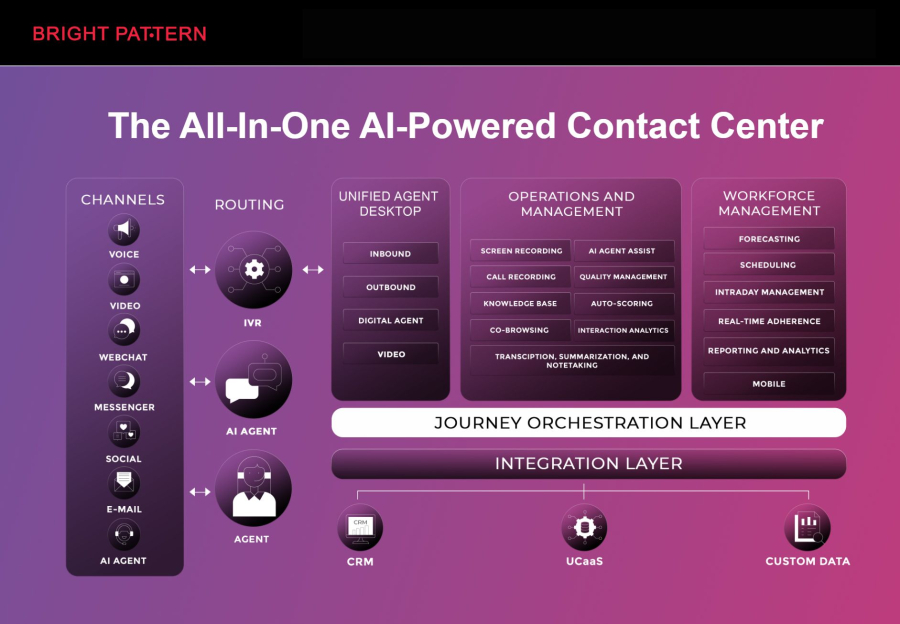
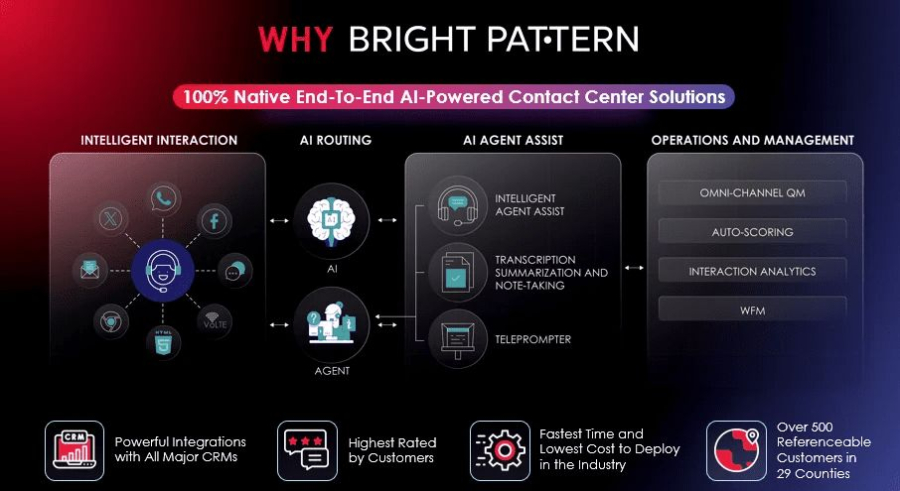
Bright Pattern is a versatile cloud-based contact center solution designed to help businesses implement generative AI for customer service. It enables organizations to deliver omnichannel support, streamline operations, and improve agent productivity.
Key features include:
- AI-driven chatbots and virtual assistants for instant support
- Integration across phone, email, chat, and social channels
- Advanced analytics for monitoring customer interactions and agent performance
- Automated workflows to reduce repetitive tasks and response times
- Personalized customer journeys based on AI insights
Bright Pattern is ideal for businesses of all sizes looking to modernize their support operations, reduce costs, and enhance the overall customer experience with AI-powered efficiency.
2. Five9: Cloud Contact Center Solutions
Five9 provides AI-enhanced call center software to improve agent productivity and customer satisfaction. Its intelligent routing and speech analytics capabilities help deliver personalized support across multiple channels.
3. Genesys Cloud CX: Omnichannel Experience
Genesys offers a scalable contact center platform integrating AI tools for predictive engagement, chatbots, and workforce optimization. It focuses on providing seamless customer experiences across digital and voice channels.
4. RingCentral Contact Center: AI-Powered Communication
RingCentral delivers cloud-based AI solutions for call centers with features like real-time transcription, sentiment analysis, and automated workflows to help agents resolve issues faster.
5. 8x8 Contact Center: Unified AI Solution
8x8 provides generative AI-driven tools to assist in customer communication, including virtual agents, analytics dashboards, and omnichannel support capabilities.
6. NICE inContact CXone: AI Customer Experience Platform
NICE inContact integrates AI to improve call center efficiency with intelligent routing, self-service automation, and predictive engagement features. Its AI-driven insights help businesses deliver faster resolutions and more personalized support.
7. Talkdesk CX Cloud: AI-Enhanced Support
Talkdesk’s platform leverages AI to streamline call handling, automate repetitive tasks, and deliver actionable insights for improving the customer experience. It also helps optimize agent workflows and enhances multichannel engagement.
8. Avaya OneCloud: Intelligent Customer Engagement
Avaya OneCloud combines AI-driven insights, multichannel routing, and workforce optimization to ensure consistent service quality and personalized interactions.
9. Zendesk Talk: AI for Customer Support
Zendesk Talk integrates AI tools for automating support tasks, managing inbound queries, and enhancing agent performance for small and medium-sized businesses.
10. Freshdesk Contact Center: AI-Integrated Platform
Freshdesk offers AI-powered chatbots, ticketing automation, and omnichannel analytics to help contact centers deliver faster and smarter customer service.
What Is Generative AI in Customer Service?
Generative AI in customer service refers to AI systems that can understand natural language, generate human-like responses, and take action based on the customer's intent. Instead of relying on pre-written scripts or decision trees, these systems use large language models to create responses on the fly, tailored to each conversation.
In practice, this means an AI assistant can read knowledge base articles, past tickets, product documentation, and policies, then use that information to respond accurately and consistently across channels.
Key Capabilities of Generative AI for Support Teams
- Natural, conversational languagethat feels more like talking to a skilled human agent than clicking through a bot menu.
- Context awarenessacross the conversation, so the AI remembers what has been said and avoids repetitive questions.
- On-the-fly answer generationusing existing documentation, tickets, and guides instead of rigid, pre-coded replies.
- Multi-channel supportacross chat, email, messaging apps, and even voice, with consistent quality.
- Action takingsuch as creating tickets, updating orders, or capturing feedback when connected to your existing systems.
- Agent assistance, where AI suggests responses, drafts messages, and summarizes threads to help human agents work faster.
The Business Benefits of Generative AI in Customer Service
Adopting generative AI is not just a technology upgrade; it is a business growth lever. When implemented thoughtfully, it boosts customer satisfaction, reduces operational costs, and unlocks new insights for continuous improvement.
Benefits for Customers
- Always-on availability.Customers can get help 24/7 without waiting for business hours or sitting on hold.
- Faster answers.AI can surface relevant information in seconds, cutting down time to first response and time to resolution.
- Consistent experiences.Every customer gets accurate information aligned with your policies, regardless of who is on shift.
- Personalized support.Generative AI can use customer history, preferences, and context to tailor responses and recommendations.
- Seamless handoffs.When needed, the AI can transfer the conversation to a human agent with a full summary, so customers avoid repeating themselves.
Benefits for Support Agents
- Reduced repetitive workload.AI handles high-volume, simple questions so agents can focus on complex, high-value interactions.
- Faster case handling.Draft replies, suggested next steps, and instant summaries help agents resolve tickets more quickly.
- Better onboarding and training.New agents can lean on the AI assistant as a real-time coach, guiding them to the right information and tone.
- Lower burnout.With fewer repetitive inquiries and better tools, agents can focus on meaningful conversations that use their skills.
Benefits for Business Leaders
- Scalable support without linear headcount growth.Generative AI absorbs volume spikes and growth without constant hiring.
- Improved customer satisfaction and loyalty.Faster, more personalized support builds trust and drives repeat business.
- Operational efficiency.Intelligent automation reduces handling time, routing errors, and manual effort.
- Data-driven decisions.AI systems can surface trends, common pain points, and emerging issues across thousands of conversations.
High-Impact Use Cases of Generative AI in Customer Service
Generative AI can support nearly every stage of the customer journey, from pre-sale questions to post-purchase troubleshooting and retention. Below are some of the most impactful and practical applications.
| Use Case | Description | Primary Business Impact |
| AI Customer Assistant | Conversational assistant on web, mobile, or messaging channels answering questions and helping customers self-serve. | Reduces incoming ticket volume and speeds up resolution. |
| Agent Assist | Real-time suggestions, reply drafts, and knowledge surfacing inside the agent's workspace. | Improves agent productivity and response quality. |
| Automated Ticket Triage | AI reads incoming messages, detects intent and urgency, and routes them to the right team or workflow. | Shortens handling time and ensures priority issues are escalated quickly. |
| Email and Message Automation | Generative AI drafts personalized email replies or message responses for agent review or direct sending. | Speeds up backlogs and improves consistency across channels. |
| Knowledge Management | AI suggests new help center articles, updates outdated content, and surfaces the best answers for each question. | Keeps knowledge fresh and relevant without heavy manual effort. |
| Call Summarization | After a phone or video call, AI generates a concise summary, action items, and next steps. | Reduces post-call admin time and improves follow-through. |
| Proactive Support | AI analyzes patterns, identifies recurring issues, and helps send proactive messages or guidance. | Prevents tickets and boosts customer confidence. |
How Generative AI Fits Into Your Support Stack
Generative AI works best when it complements your existing tools and workflows instead of replacing them outright. It can sit alongside your help desk, CRM, knowledge base, and telephony systems, enhancing each without requiring you to start from scratch.
From Scripted Chatbots to Generative AI Assistants
Many organizations already use traditional chatbots that rely on rules and decision trees. Generative AI assistants take this further by understanding open-ended questions, interpreting nuance, and handling unfamiliar phrasing.
- Rule-based chatbotsexcel at handling very specific tasks with predictable flows, such as checking an order status using a predefined menu.
- Generative AI assistantsare better suited for free-form questions, complex issues, and conversations that require flexibility.
In practice, a powerful setup combines both: rule-based flows for simple transactions and generative AI for natural conversation and knowledge retrieval.
Core Systems Generative AI Can Enhance
- Ticketing and help desk platforms.AI can assist with ticket categorization, prioritization, and response drafting.
- Knowledge bases and FAQs.Generative AI can turn static articles into dynamic, tailored answers.
- CRM and customer profiles.With access to customer history, AI can personalize recommendations and troubleshooting steps.
- Voice and call centers.Transcription and real-time hints help agents handle calls more confidently and efficiently.
Implementation Roadmap: How to Get Started
Implementing generative AI for customer service does not have to be overwhelming. A phased approach lets you prove value early, build trust with stakeholders, and expand confidently.
Step 1: Define Clear Objectives
Begin with well-defined goals so you can measure impact. For example, you might aim to reduce average handling time, increase self-service resolution rates, or extend support coverage without adding headcount. Clear objectives guide every subsequent decision, from technology choices to rollout strategy.
Step 2: Audit Your Content and Data
Generative AI is only as effective as the information it can access. Review what you already have:
- Help center articles and FAQs.
- Internal wikis and troubleshooting guides.
- Past tickets and email threads.
- Product and policy documentation.
Identify gaps, inconsistencies, or outdated content, then prioritize improvements. Strong, reliable documentation gives the AI a solid foundation to generate accurate answers.
Step 3: Start With a Focused Use Case
Instead of attempting a full-scale transformation from day one, start with a targeted use case such as:
- An AI-powered assistant for a single product line or region.
- Agent assist in email support, where AI drafts replies that agents review.
- Automated triage for incoming tickets to categorize and route them.
Choose an area where you can quickly measure success and gather feedback from both customers and agents.
Step 4: Integrate With Existing Workflows
For adoption to stick, AI should fit naturally into how your teams already work. Focus on:
- Single sign-on and unified inboxesso agents do not need to switch tools.
- Clear handoff protocolsfrom AI to human agents.
- Configurable guardrailsso AI uses approved sources and stays aligned with your tone of voice.
Step 5: Iterate, Learn, and Scale
Once the first use case is live, collect feedback, review sample conversations, and adjust prompts, policies, and training data. Over time, you can expand generative AI to more channels, languages, and customer segments, guided by what works best.
Best Practices to Maximize Value From Generative AI
To unlock the full potential of generative AI in customer service, combine strong technology with thoughtful operational practices.
Keep Humans in the Loop
Generative AI is a powerful assistant, not a replacement for human empathy and judgment. Give agents review and override capabilities, especially in sensitive situations such as billing disputes, cancellations, or complex technical issues. Human oversight maintains quality, builds trust, and provides valuable training signals for the AI.
Design a Consistent Tone and Voice
Customers should experience your brand consistently, whether they speak to a human agent or an AI assistant. Define your preferred tone of voice, then configure prompts and examples so the AI responds in a way that feels on-brand, friendly, and respectful.
Continuously Improve Your Knowledge Base
As agents and AI surface new or recurring questions, turn those into structured articles, guides, or workflow steps. The better your underlying knowledge, the more accurate and helpful your AI-powered experiences become.
Monitor Conversations and Outcomes
Regularly review AI-driven interactions to understand how customers respond and where improvements are needed. Look for patterns such as confusion around certain topics or missed opportunities to upsell or educate. Use these insights to refine prompts, content, and routing rules.
Key Metrics and KPIs for Generative AI in Customer Service
To demonstrate success and secure ongoing investment, track metrics that reflect both efficiency and customer experience. Useful indicators include:
- Self-service resolution rate.The percentage of inquiries resolved by AI without human intervention.
- Average handling time.How long it takes to resolve a case, and how that changes when AI is involved.
- First contact resolution.Whether issues are solved in a single interaction.
- Customer satisfaction scores.Feedback after AI-assisted conversations compared with purely human-handled ones.
- Agent productivity.Tickets or interactions handled per agent, especially in queues where AI provides assistance.
- Deflection of simple queries.Reduction in repetitive, low-complexity tickets over time.
The Future of Generative AI in Customer Service
Generative AI is still evolving, and its role in customer service will only grow more significant. Looking ahead, you can expect:
- Richer omnichannel experiences.AI that seamlessly follows the customer across web, mobile, email, messaging, and voice without losing context.
- Deeper personalization.Recommendations, offers, and guidance that reflect each customer's history and preferences.
- More proactive support.AI that spots issues before customers do and offers solutions in advance.
- Tighter alignment with the rest of the business.Support insights feeding directly into product development, marketing, and sales strategies.
Organizations that embrace generative AI now are positioning their support teams as strategic, data-rich partners that directly influence revenue, loyalty, and brand perception.
Conclusion: Turning Customer Service Into a Growth Engine With Generative AI
Generative AI for customer service is more than a trend. It is a practical, high-impact way to deliver faster resolutions, more human conversations, and exceptional experiences at scale. By starting with clear goals, strong knowledge foundations, and a human-in-the-loop mindset, you can harness AI to elevate every interaction your customers have with your brand.
Adopted thoughtfully, generative AI turns customer service from a cost center into a powerful growth engine that delights customers, empowers agents, and drives lasting business value.
